How charities win employees from the world’s top businesses


Business Man walking into horizon

While some secondees return to the corporate world, 70% on the ProInspire programme stayed at their chosen charity. (Photograph: Cultura Creative/Alamy)

Charity secondments have become a popular way for private-sector employees to share skills and explore interests with the safety net of a job to return to. But one US organisation hopes to take the secondment model a step further and nurture the next generation of charity leaders.


ProInspire facilitates year-long fellowships for private-sector professionals to work with nonprofits in the San Francisco Bay Area and Washington DC region. Since its launch in 2009, ProInspire says it has placed more than 120 fellows in 60 local and national organisations including Community Housing Partnership,Global Giving and Meals on Wheels America.


While some ProInspire fellows return to their job, more than 70% of fellows remain with their charity at the end of their placement – most for at least one year.

ProInspire founder Monisha Kapila (recently named by the Chronicle of Philanthropy as one of its 40 under 40 influential nonprofit innovators) set up the matching scheme in response to what she saw was a lack of opportunity for private-sector professionals to easily make the transition to a nonprofit career.

“A lot of people want to use their business skills for good, and nonprofits need commercial skills,” says Kapila. “We look at how to better connect this supply and demand.”
Fellows typically have between two and five years of business experience and come from a wide range of employers, including Accenture, Google, JP Morgan and Zenith Media.

Selecting the best

Applicants go through a competitive, competency-based selection process (less than 4% are accepted), then the charity interviews finalists to select their ideal secondee. Fellowship roles can include communications, fundraising, finance, project management and technology.

Business people at conference table, portrait. Job interview panel.
Applicants for the ProInspire fellowship go through a rigorous selection process before the charity chooses their ideal secondee. (Photograph: Phil Boorman/Getty Images)


Isayas Theodros, a 2013 ProInspire fellow, swapped his job as a senior auditor at Deloitte’s Costa Mesa offices in California for the role of portfolio manager at Washington-based Partners for the Common Good (PCG), a community development funding organisation. After two-and-half years in the private sector, he was looking for a sense of purpose in his work. The fellowship involved managing borrower-lender relations and loan portfolios.

“By far, the best part of my job was assisting real people who longed to make a tangible difference in their respective communities,” says Theodros.Inspired by the experience, he remained as portfolio manager with PCG for a further year.The nonprofit host covers the fellowship cost – currently $49,000 (£34,000) in the San Francisco Bay Area and $46,500 in Washington DC. The host also pays a $7,000 fee to ProInspire for fellowship training, coaching and mentoring.

Filling skills gaps

Neha Patel, associate director of strategic planning and analysis at FHI 360, a Washington-based health and education nonprofit, says secondments help to widen the recruitment pool: “Nonprofits do need the heart but we also need the business sense, the management approach and the expertise that comes from the private sector.”A recent survey of 300 heads of digital in UK charities found that 95% had no HR strategy for improving digital skills of their employees. So could investing in secondments now pay long-term dividends?
Skilling up the sector is the focus of UK-based On Purpose, which matches business professionals with charities, typically for two six-month placements. Hosts pay an annual salary of around £21,000 and a one-off fee to On Purpose of between £5,500 and £11,000, depending on size and legal structure.For a £1,000 (plus VAT) brokerage fee, the Whitehall and Industry Group’s Charity Next will place employees on the Civil Service’s fast stream graduate programme on year-long secondments with charities such as Leonard Cheshire and Place2Be.John Lewis Partnership employees can apply for a charity secondment of up to six months via the firm’s Golden Jubilee Trust.

Nurturing volunteering

While most secondees on these schemes will return to their previous jobs, many remain involved in the voluntary sector. Benet Northcote, director of corporate responsibility at John Lewis Partnership, says: “Seventy-five per cent of our secondees continue to volunteer for the [host] organisation, or another one.”

Elle Bradley-Cox spent four days a week over four months on secondment from her role as PR and marketing co-ordinator at John Lewis Sheffield to the learning disability charity Work Ltd. During her stint, which gained her a Business in the Community award, she developed a marketing strategy, PR plan and branding for the charity. “I also helped them launch their own social media presence which allowed the charity to better promote the great work they do,” says Bradley-Cox. “I was thrilled to be awarded the [BITC] award … not least because it helped to give the charity even greater exposure.”

Visions of hope

“Art washes away from the soul the dust of everyday life.” Pablo Picasso

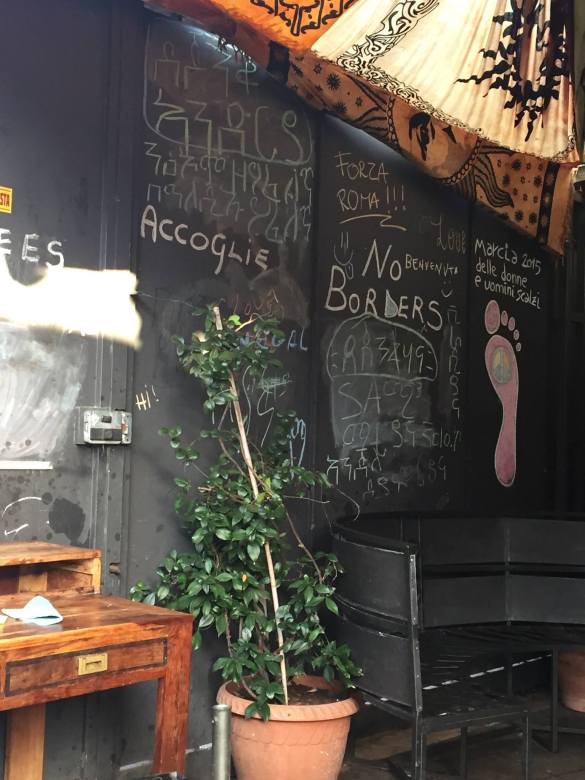
Last week, I visited the Baobab refugee centre in Rome as part of The 19 Million Project – a gathering of journalists, designers, digital strategists, coders and humanitarians from around the world with a focus on developing innovative ways of storytelling around the refugee crisis.

The women, men and children I met there were full of hope and joy, anxiety and frustration. Their journey has been long, dangerous and frightening. But the people I spoke to are inspired to continue by the promise of a better life.

The beautiful artwork at this centre – by several artists including Alice Pasquini – is inspired by the hopes and dreams of people like us who just want the right to live in peace.

This slideshow requires JavaScript.


Crucial questions for journalists during the refugee crisis

Credit: Nando Sigona

Credit: Nando Sigona

This article first appeared on the 19 Million Project website

“We need to humanize the refugee crisis,” UK-based migration specialist Nando Sigona told the 19 Million Project audience in Rome during a Skype interview on Wednesday.

Sigona, senior lecturer in migration and citizenship at the University of Birmingham in England, challenged journalists to look at the stories behind the stats, rather than treating people as “generic refugees”.

What is it like to spend four years in a refugee camp? What are the issues facing the generation of children born in camps? These are some of the questions that journalists should be asking, said Sigona. “Attempts to humanize are very important.”

Sigona urged journalists to remain inclusive about their coverage of migration stories, given the inter-sectionality of refugees: “There is a risk in the representation of ‘good’ refugees versus ‘bad’ ones,” he said. “Who does deserve our protection? Syrians are not the only ones who do.”

And while data can be a powerful tool, Sigona cautioned users to keep an eye on the bigger picture. “Numbers have power but we need to pay much more attention to how numbers are used,” he said, citing the “complete conflation” of immigration with figures on arrivals by the sea.

Measures to promote integration of refugees in their host countries vary wildly. But Sigona says he is encouraged by positive actions emerging from the Mediterranean crisis, such as Germany translating its constitution into Arabic and offering English as well as German language courses, to assist incoming refugees.

A key issue for journalists to consider over the coming months, says Sigona, is the “economy of the crisis” and its beneficiaries – such as security contractors employed by EU border management agency, Frontex. “Who is making money out of it?”

Dare to be different: why foundations should take risks to tackle social problems

Surfer shooting the curl of Jaws at Peahi on Maui

By taking a risk, foundations are able to support charities in achieving sustainable change. Credit: Ron Dahlquist/Corbis

This article originally appeared in The Guardian

The news that giving by the UK’s top 300 charitable foundations has increased year-on-year to £2.5bn is a welcome chink of light amid the gloom of public sector spending cuts. But a new study into what foundations fund says more should support innovative or risky projects if they want to tackle the root causes of social problems and not just plug funding gaps.

The report by Cass Business School’s Centre for Charitable Giving and Philanthropy (CGAP) examined how much philanthropic foundations are contributing to support research and innovation. While research is widely funded, only just over a third of respondents fund innovation.

The report concludes: “In an era of social, economic and political turbulence, there is an opportunity to increase the contribution of foundations to new approaches and solutions.”

The UK report is part of a Europe-wide study, funded by the European Commission, into research and innovation spending by foundations. Professor Cathy Pharoah, report co-author and CGAP co-director, suggests foundations should share knowledge more systematically and work more closely with partners to deliver their programmes. “It’s getting harder to take risks because money is so tight and there is an increasing demand for evidence,” she says. “Collaborative funding – where the risks are shared – is one way out of that.”

Funding root causes

In the UK, LankellyChase Foundation is one of the most visible proponents of tackling social problems in partnership with statutory and non-profit partners. By targeting people who face severe and multiple disadvantages, the foundation aims to support “systems change” – which is defined in a 2015 publication from New Philanthropy Capital as “altering underlying structures and supporting mechanisms which make the system operate in a particular way”. In other words, tackling root causes.

Alice Evans, director of systems change at LankellyChase, says the problem with traditional interventions is that they only paper over the cracks. “We are funding people to look far more at the root causes and systems,” she explains.

Launched in 2013, Love Barrow Families is a partnership between Cumbria Partnership NHS Foundation Trust and Cumbria County Council to improve the way adult and child health and social care services work together to meet the complex needs of families in Barrow. Backed by a £90,000 annual grant from LankellyChase, the project has improved school attendance, reduced anti-social behaviour and involved families as volunteers in their communities.

“We are funding this because we think it should be the blueprint for how Barrow and Cumbria can redesign services,” says Evans.

LankellyChase is also funding System Changers, a six-month pilot to gather insight from frontline workers in homelessness and drug services in the north of England, to improve the way clients are supported. Evans says these voices are often unheard but can help shape what needs to change. The results will be shared locally and nationally next year.

Daring and different

The Lipman Family Prize is an annual global award that celebrates innovation with an emphasis on impact and transferable practices. First awarded in 2012, it is administered by the US University of Pennsylvania through Wharton School, the school of award founder Barry Lipman.

The recently-doubled prize offers $250,000 of unrestricted funding to one main winner, and $25,000 each to two runners up. The 2015 winner, Riders for Health, manages motorcycles, ambulances and other vehicles to ensure smooth delivery of health care in seven countries across Africa.

Breakthrough, winner of the 2014 award, is a global human rights organisation working to make violence against women and girls unacceptable. Much of its work involves quick-response, multimedia campaigns to mobilise communities.

Umi Howard, director of the Lipman Family Prize, admits Breakthrough could be seen by traditional philanthropists as a “risky pick” because of its “huge mission” to prevent violence against women by transforming the norms and cultures that enable it.

Howard says: “We won’t know if they achieve their culture change goals for a decade or more. Relying on hard numbers in terms of outcomes, the prize committee could have easily gone another way, but instead selected Breakthrough as a group doing something daring and truly different.”